
The earlier parts in the Bali Journal
Our second day in Bali started off as a rainy day too. By now I knew the skies were merely mocking us with the grey sombre look and splatter of rain with no intention of raining on our parade. Sure enough, by the time we were done with our breakfast (and I must say Bistro Batu Kali gives you of its best) and were ready to leave, the clouds were slowly moving out in search of other patches of sky to occupy and new sets of people to threaten (or bring joy, as the case may be).
When Arjun (our charioteer) stopped the chariot car at our first destination, we could see buses emptying loads of people. They were all making way to an entrance where this beautiful damsel waited to receive us.
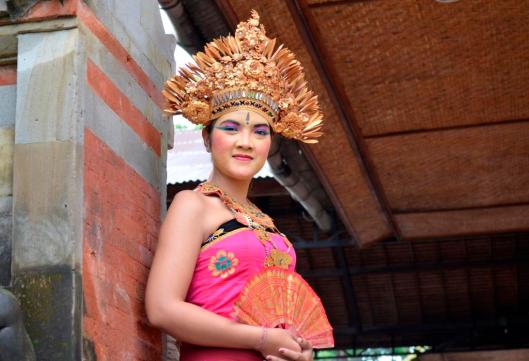
We were to watch the Barong Play (also called Barong & Kris (sword) Dance. The paper handed out to us at the ticket counter told the tale but seemed all garbled. No English teacher if they were to grade it was going to give pass marks to the writer. I had to google about the play to make some sense out of it all. But that further confused me because there seems to be more than one version or way for this dance to be presented. On one point things were very clear: The Barong dance is about the eternal fight between good and evil. Barong is a mythical animal that represents good and Rangda the monster is the mythical evil one. The masks of Barong and Rangda are considered sacred items in Bali, and before they are brought out, it is a must that a priest be present to offer blessings.
The musicians were already seated (as were many viewers) and playing on their instruments while we entered.

Now to the Barong dance itself: The dance starts with a tiger making an appearance. He looks so cute, with a shaggy coat and snapping jaws, as he stares at the audience with his wide mask eyes.


Then comes the monkey. He plays around with the tiger, fools him into believing he has thrown him something while in reality the monkey hides it behind his back. Much the same as we do with our dogs sometimes: Hey there, catch! And when the dog runs and looks for it, you take out whatever it is that is still is in your hand and wave it, saying, Fooled ya! I should know, I do that a lot to Luci.

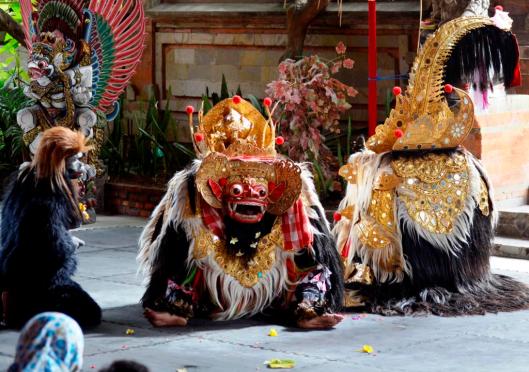
Getting away from the topic of Luci (There is the danger that I may go off at a tangent) and back to the play, while the monkey and the tiger are at their games, three masked dancers appear. According to the literature provided, the three men are angry with the tiger because it killed a child of one among them. They attack the tiger. The monkey helps the tiger.

Now don’t ask me how this is connected to the story that follows. I am actually clueless. May be it is just a prelude. By the way, there is some crass humor too in this act, when the men catch the monkey and pull something out from between its legs that looks exactly like a you-know-what (If I name it I will get more spammers wanting to sell their ware to me). After some suggestive moves, these men then pull it further and it is revealed to be the tail after all.
Anyway, in the next act, and actually the first, appear two female dancers. They are servants of Rangda the evil witch, who rules over the spirits of darkness. These servants are looking for the servants of Dewi Kunti (yes the same from the epic Mahabharata) who on their part are on their way to meet the Patih (Prime Minister).

Now comes the second act: One of the servants (obviously a witch herself) of the evil Rangda, enters both the servants of Dewi Kunti. When these demon-infested servants meet the Patih (Prime Minister) his body too is invaded successfully by the servant witch. So all three of them are now possessed (this is conveyed to the audience by them sporting on ears or having leaves in their hands), and make way towards Dewi Kunti.

In the third act, Kunti makes her appearance,

followed by Sedewa (Sahadeva)
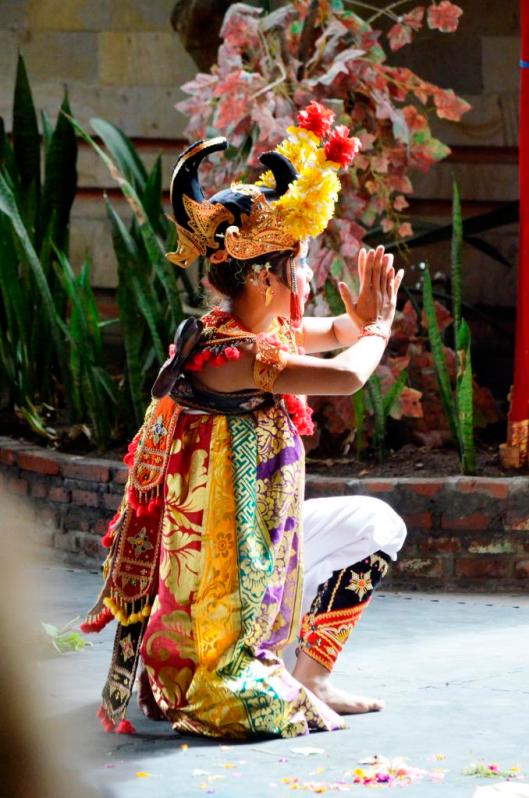
No prizes for guessing that by now the witch manages to enter and posses Kunti too. For some reason which is really unclear (and not explained) Kunti has promised the evil Rangda that she would sacrifice her son. She orders the Prime Minister to bring Sedewa to the forest.

Poor Sedewa, no amount of asking his Mom elicits a satisfactory answer as to why he is being sacrificed. Everyone on stage at that point, other than Sedewa, have gone bonkers under the influence of Rangda. So, Sedewa is taken prisoner and tied to a tree, awaiting beheading.
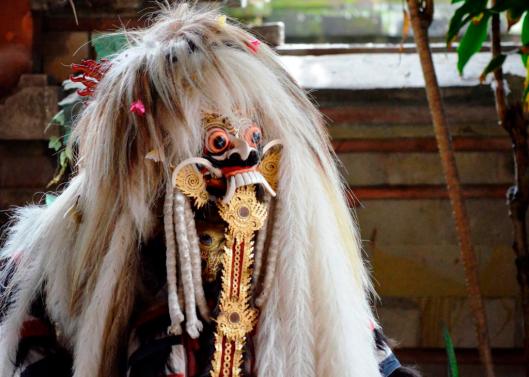
In the fourth act, Lord Shiva comes unknown to anyone and grants immortality to Sedewa. Rangda enters all eager to victoriously kill Sedewa. But worse luck, poor evil witch fails to take into account boons from Gods. She fails in her attempts. Better sense prevails and she surrenders to Sedewa requesting redemption. Magnanimous Sedewa agrees, kills her and she goes to heaven.
Hmmm…. I must say things are easy for the bad guys always. Look at the many instances in our epics where the bad guys end up with an easy route to heaven. I don’t mean the medium bad guys, but the really, really bad and cruel ones. They have it real good. They are bad all their life, torture people, indulge in the most atrocious activities. Then along comes their nemesis, the extra good one who they fight and inevitably get killed by. Voila, the doors of Heaven are now wide open for them. So tell me again, WHY exactly are we asked to be good? Methinks being evil is rewarded rather than being even medium-good! I can’t think what sort of message we send to people through these “bad guys go to heaven” stories. That its good to be bad (excuse the choice of words) do all the wrong things, terrorize people and then get yourself a one-way ticket to heaven by getting killed by someone really great? Maybe that is why we have demons amongst us too, terrorizing us in daily life like the rapists of Nirbhaya in Delhi.
Anyways, Rangda goes to heaven. Now, naturally so, Kalika, the witch’s servant also wants to go to heaven. I mean, you can’t blame her, can you? She has been a loyal follower of Rangda, right? So her desire is understandable. She humbly requests Sedewa to kill and give her redemption too.

Sedewa says, no go! Kalika is infuriated and thus in the place of the evil just mitigated, another is born in the form of an angry Kalika. She turns herself into a boar and fights Sedewa. When she is about to be defeated she changes herself into a bird and fights him again.
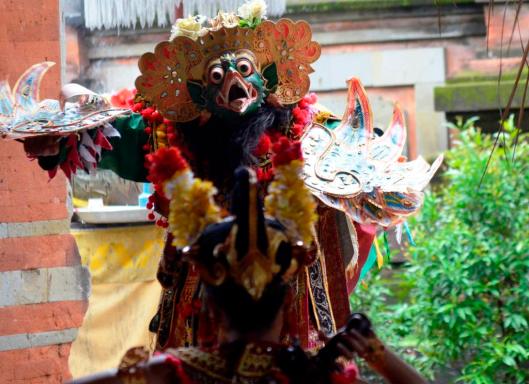
Once again on the verge of defeat, she changes herself into Rangda. Is there a lesson in this for us? Rangdas are created from the injustice and unfairness of the world. At least it seems so to me, it is NOT something the play conveys but my own view.
In Kalika’s avatar as Rangda, Sedewa is not able to defeat her. Don’t ask me why, since Sedewa already defeated one other Rangda, the one who was even then watching proceedings from heaven. How come this Rangda is too powerful for him to defeat? Is the answer that the good and evil balance each other out and only when the balance tilts does someone step in to maintain it? (But why?) Is that why a new Rangda was allowed to grow by Sedewa himself, much like politicians all over the world who create things for short term goals and later end up fighting it?
Getting back, now that Sedewa realizes he is unable to kill this new Rangda, he meditates and turns himself into a Barong. Yup, the same huge (but cute) tiger/lion we saw in the first intro.The fight is still not easy. Barong is powerfu, but the Rangda is equally powerful. It is a face off.

So the dance ends with the message, the fight between good and evil does not ever end… it goes on forever, even to this day, everywhere in the world.
Our charioteer Arjun was waiting for us as we came out of the dance arena. We had more things to see that day: batik painting, wood carving, etc. We saw many temples also as we drove through. By now we were slowly climbing to a higher level. It had started to drizzle too. Where to next, Arjun? the BIL asked. “Let’s have coffee,” was the reply from the charioteer. So let’s meet for coffee next time, shall we?
(To see a small clip of the Barong dancing, click here)
 Shail's Nest
i love the barung dancing.. but i must say the ceremonial version (not the one for tourists) is a thing to see!! i was the only westerner at the temple with my balinese boyfriend and it was honestly freaky stuff! very spiritual and in some ways haunting watching these dancers be possessed by spirits
Ahh I wish I could have seen that version! 🙂 And welcome to Shail’s Nest 🙂
Seems and looks very magical, and I love the pictures
Thank you. It was very enjoyable 🙂
Beautiful pictures. Can see that you had a great time.
Yes, Bindu. It was one wonderful trip 🙂
Great pictures and I love the way you have described the Dance and the story ! Its amazing isnt it how similar our mythologies are ! I love the colourful dresses and the make up !
I think you had a great time but I have a feeling that someone was missing Luci a wee bit 😛
I missed Luci a LOT! 😉
Barong seems like something not to be missed.
It was fun watching 🙂
Wow Shail! What a colourful performance and thank you so much for providing a blow by blow explanation of the action. My favourite is the lion – even if he does eat little boys! I never associate Bali with rain – I suppose it is the `wrong` season eh? But it all looks so colourful.
The season was yet to start. But thankfully, the rain did not play spoilsport 🙂
The dancers wear such colorful costumes and masks
Loved the pictures and the story, and most of all your interpretations and comments.
I am glad you noticed the interpretations and comments 🙂
Have you read or seen watchmen? I have a copy of the graphicnovel.. If I find another copy, I shall send or if you perk up interest and wish to read it, I will LOAN it to you. There is a quote in it:
Rorschach writes in his journal: This city is afraid of me. I have seen its true face. The streets are extended gutters and the gutters are full of blood and when the drains finally scab over, all the vermin will drown. The accumulated filth of all their sex and murder will foam up about their waists and all the whores and politicians will look up and shout “Save us!”… and I’ll whisper “no.”
I hope that is the type of lessons we were given instead of the stairway to heaven. Ofcourse there are alternate descriptions that they are sent to heaven because they did their role of balancing good and bad, or that they were just causing bad to people who had bad karma in them from previous births.. Depends on who you ask..
Tigers are cute, I have always wanted one to be honest.
Achha, I will also try to youtube the dance..
I hope to read more of our travelogues when you make more trips to other places
The sure does sound interesting. Maybe I will read it too.
I think I am enjoying writing this so much that I might hence forth do more of travelogues when I travel. Of course it will be my own type of travelogues, with digressions and all :D.
Hmmm… the myriad ways of representing the good vs evil… and yet it goes on! Each country and tradition have their lore, and this onemade for really interesting reading , Luci references included 😀
The pictures were lovely!
Arjun? OH 🙂
Thank you, Usha 🙂 Arjun was mighty pleased to know we were familiar with the original Arjun 🙂
And of course, you have your own Arjun 🙂
Enjoyed a good read this lazy afternoon. Loved the pictures and your narrative sequences! Have always wondered about the origin of Hindu influences in Indonesia which has a larger muslim population.
Welcome to Shail’s Nest Shreeja 🙂 Wiki says,”Islam was brought into Indonesia by traders from Gujarat, India during the eleventh century, although Muslims had visited the archipelago early in the Muslim era. By the end of the 16th century, Islam, through conversion, had surpassed Hinduism and Buddhism as the dominant religion of the peoples of Java and Sumatra. Bali retained a Hindu-practising majority, while the eastern islands remained largely animist until the 17th and 18th centuries when Christianity became predominant in those areas.” From here: http://en.wikipedia.org/wiki/Spread_of_Islam_in_Indonesia
Imagine that! 🙂 From Gujarat? News to me too 🙂
Nice depiction. Looks like we have a travel book in the offing.
If that means more of travel, I won’t mind, Vivek 🙂
Fascinating and beautiful!
Thank you and welcome to Shail’s Nest Ladyfi 🙂
Gorgeous, colorful photos; thank you…
Glad you liked them, Lindy 🙂
Pingback: The Bali Journal: Kopi luwak | Shail's Nest
Pingback: The Bali Journal: Kintamani | Shail's Nest
Pingback: The Bali Journal: Turtle Island | Shail's Nest
Pingback: B for Barong | Shots and captures
Loved all the pictures
Thank you and welcome to Shail’s Nest 🙂